Claude's Constitution is now an audiobook, read by two of its authors, Amanda Askell and Joe Carlsmith. It includes a Q&A on the writing process, the philosophies that shaped the document, and how it might change as models become more capable. Listen at https://t.co/dKMfpeOblm
The Claude Platform on AWS is now generally available. AWS customers get the full set of Claude API features, with AWS authentication, billing, and commitment retirement.
New in Claude Code: agent view. One list of all your sessions, available today as a research preview.
We're introducing the Claude Platform on AWS. This gives developers access to the same models and features as our native API, including Claude Managed Agents! Workloads, billing, and IAM stay inside AWS. Learn more: https://t.co/JihmaHyOp2
Agent view is built to run more sessions in parallel with less to keep in your head.
New Anthropic research: Teaching Claude why. Last year we reported that, under certain experimental conditions, Claude 4 would blackmail users. Since then, we’ve completely eliminated this behavior. How?
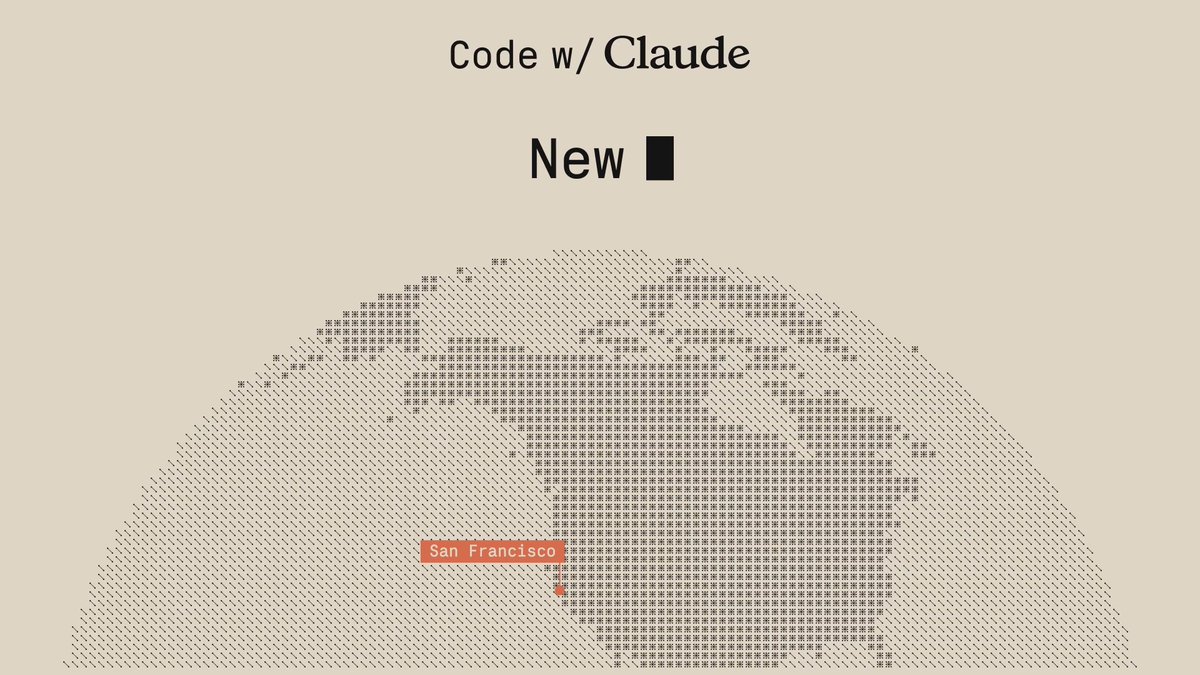
That's a wrap on Code with Claude San Francisco! Clawd had an amazing time, and we hope you did too. Thanks to everyone who came out and everyone who tuned in 🧡
Last week we shipped 50+ Claude Code reliability fixes. This week it's 60+ more. Smoother long-running sessions, a more efficient agent loop, auth that works in more environments, and terminal fixes: 🧵
/radio
We're co-hosting a couple of hackathons in San Francisco next week. Come build with Claude 👇
We’re sharing the research agenda of The Anthropic Institute, or TAI. TAI will focus on four areas: 1) Economic diffusion 2) Threats and resilience 3) AI systems in the wild 4) AI-driven R&D Read the full agenda:
New Anthropic research: Natural Language Autoencoders. Models like Claude talk in words but think in numbers. The numbers—called activations—encode Claude’s thoughts, but not in a language we can read. Here, we train Claude to translate its activations into human-readable text.
Our security bug bounty program is now public on HackerOne. We've run the program privately within the security research community, and their findings have strengthened our products. Now anyone can report vulnerabilities and get rewarded.
We’re donating Petri, our open-source alignment tool, to @meridianlabs_ai, so its development can continue independently. Working with Meridian Labs, we’ve also released a major update that improves the adaptability, realism, and depth of Petri’s tests.
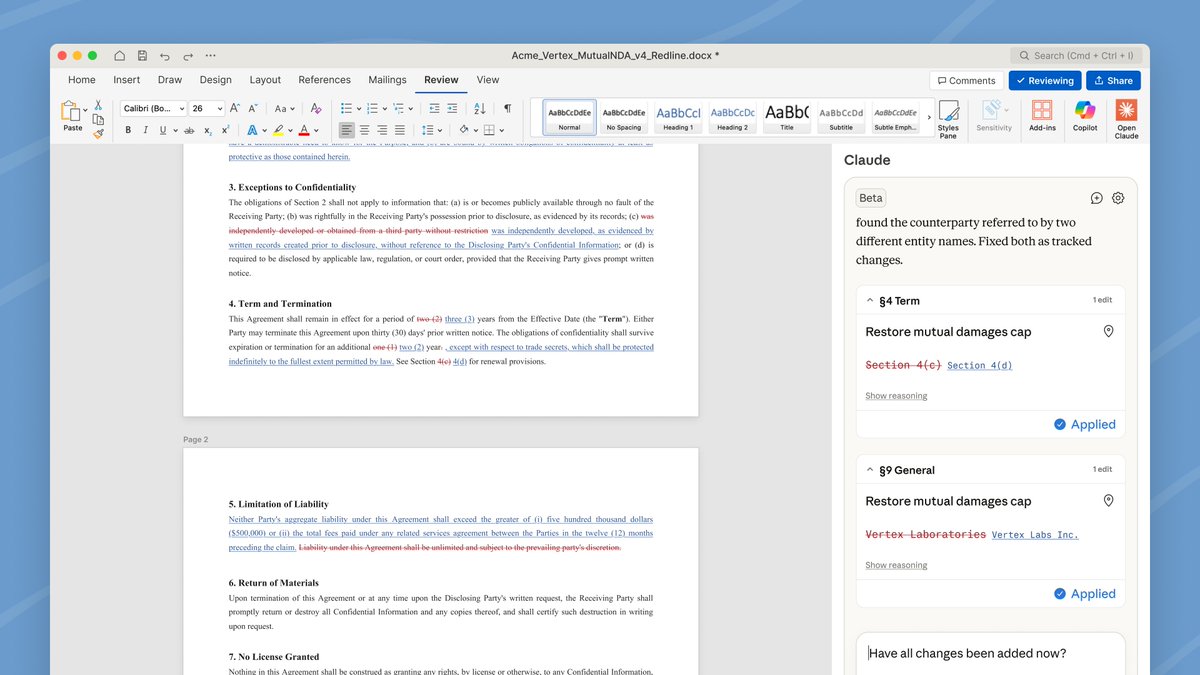
Claude for Excel, PowerPoint, and Word are now generally available, and Claude for Outlook is in public beta. As Claude moves between your Microsoft apps, it carries the full context of your conversation.
@meshtimes_ @claudeai So cute! Thanks for joining us! 🧡
@joshdbirdwell @AnthropicAI Loved having you here, Josh! 🧡
We’ve agreed to a partnership with @SpaceX that will substantially increase our compute capacity. This, along with our other recent compute deals, means that we’ve been able to increase our usage limits for Claude Code and the Claude API.
Live from Code with Claude: we're launching dreaming in Claude Managed Agents as a research preview. Outcomes, multiagent orchestration, and webhooks are now in public beta.
Join us at 1pm PT for a conversation with our co-founders Dario Amodei and Daniela Amodei, moderated by Chief Product Officer Ami Vora. https://t.co/InUxTaNimb
Code with Claude is happening now! ▪︎ 9:00AM - Keynote ▪︎ 10:30AM - What's new in Claude Code ▪︎ 11:15AM - Building on Claude at GitHub scale ▪︎ 12:00PM - Get to production faster with Managed Agents All times PT. https://t.co/O4oygkSr2G
Usage limits are up, effective today we're: 1) Doubling Claude Code's 5-hour limits for Pro, Max, Team and seat-based Enterprise plans 2) Removing peak hours limit reduction on Claude Code for Pro and Max plans 3) Substantially raising our API rate limits for Opus models
In Claude Managed Agents, we’ve added multiagent orchestration, an outcomes loop for rubric-driven self-improvement, dreaming for self-learning, & webhooks.
We love our community 🧡
Up next: ▪︎ 1:00PM - A conversation with our co-founders Dario Amodei and Daniela Amodei, moderated by Chief Product Officer Ami Vora ▪︎ 1:50PM - Watch how @bcherny and @jarredsumner build with Claude Code
As AI takes on work humans can't fully check, a capable model could deliberately hold back—and we'd never know. New Anthropic Fellows research finds that such a model can be trained to near-full capability using a weaker model as supervisor.
New Anthropic Fellows research: Model Spec Midtraining (MSM). Standard alignment methods train AIs on examples of desired behavior. But this can fail to generalize to new situations. MSM addresses this by first teaching AIs how we would like them to generalize and why.
New for financial services: ready-to-run Claude agent templates for building pitches, conducting valuation reviews, closing the books at month-end, and more. Install them as plugins in Cowork and Claude Code, or use our cookbooks to run them in production as Managed Agents.
Managing API keys is one of the top security concerns we hear from customers. Today we’re introducing keyless auth for Claude Platform: authenticate via browser with the CLI, or let workloads use their existing cloud identity (AWS, GCP, Azure, or any OIDC token provider).
Code with Claude, our developer conference, returns next week. Whether you're just getting started with Claude Code or you've been building for a while, there's a session for you. Register for the livestream: https://t.co/GJwOPMDLEC
How do people seek guidance from Claude? We looked at 1M conversations to understand what questions people ask, how Claude responds, and where it slips into sycophancy. We used what we found to improve how we trained Opus 4.7 and Mythos Preview.
Claude Security is now in public beta for Claude Enterprise customers. Claude scans your codebase for vulnerabilities, validates each finding to cut false positives, and suggests patches you can review and approve.
The Built with Opus 4.7 Claude Code hackathon is a wrap! Thank you to the 500 participants worldwide, and to @cerebral_valley for co-hosting. Here's how the winners combined multi-agent orchestration, persistent memory, MCP tools, sandboxed execution, and smart prompt design 🧵
In new Anthropic Fellows research, we discuss “introspection adapters": a tool that allows language models to self-report behaviors they've learned during training—including potential misalignment.
New on the Science Blog: We gave Claude 99 problems analyzing real biological data and compared its performance against an expert panel. On 23 problems, the experts were stumped. Our most recent models solved roughly 30% of those—and most of the rest.
Another Claude Code hackathon comes to an end. Thank you to everyone who spent a week building with Opus 4.7, and to @cerebral_valley for co-hosting. Introducing the winners:
Claude Code ships with a built-in skill for working with the Claude Platform. Useful for model migrations, using API features (e.g., prompt caching), or onboarding to newer APIs like Claude Managed Agents.
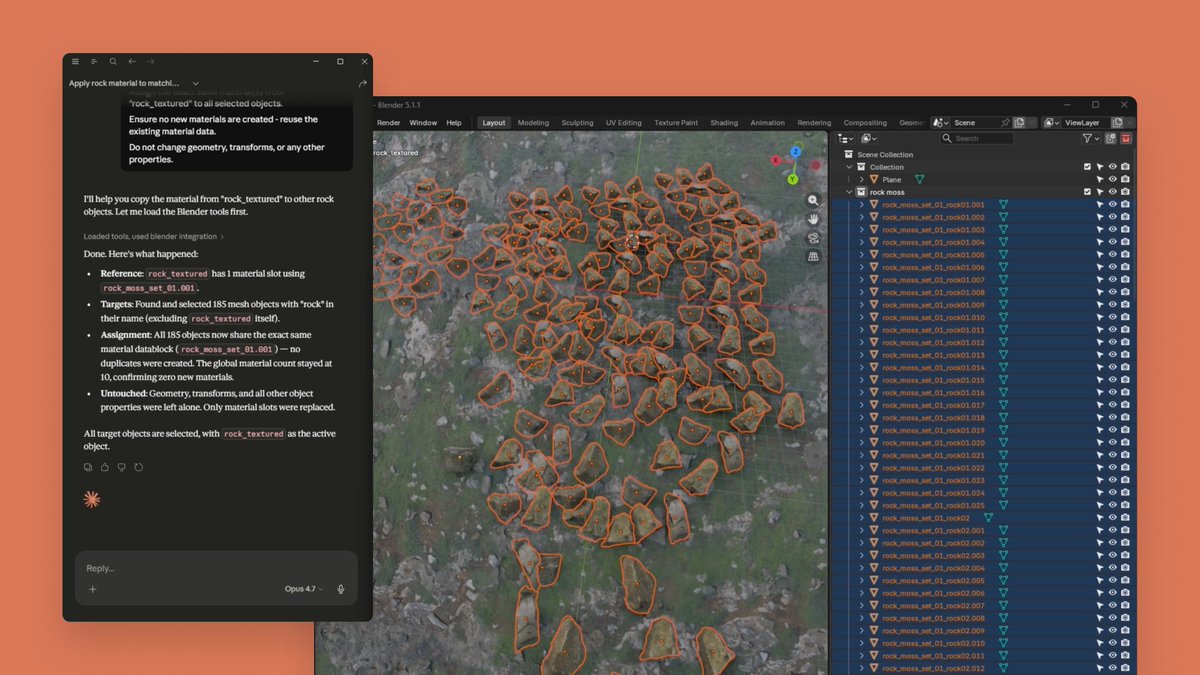
Claude now connects to the tools creative professionals already use. With the new Blender connector, you can debug a scene, build new tools, or batch-apply changes across every object, directly from Claude.
Claude Code can now send push notifications to your phone when a long task finishes or Claude needs your input. Walk away from the terminal, we'll let you know when it's done.
In the last four Claude Code CLI releases, we’ve shipped 50+ stability and performance fixes. Faster resume, stable auth, lower memory, fewer hangs: 🧵
New Anthropic research: Project Deal. We created a marketplace for employees in our San Francisco office, with one big twist. We tasked Claude with buying, selling and negotiating on our colleagues’ behalf.
新研究 Project Deal。我們在 SF 辦公室搞了個市集實驗,但有個轉折:讓 Claude 替同事們做買賣、議價。
New look. We updated the look of https://t.co/EKyctqSCXB to match the redesign of the Claude Code desktop app — new sessions sidebar, drag-and-drop layout, and a refreshed routines view.
We’ve refreshed Claude Code on the web and mobile. A few things that recently shipped 🧵
Claude Code 網頁版跟手機版更新了。最近上線的幾個重點。
Claude can now connect to more of the apps you use outside of work, including @Tripadvisor, @bookingcom, @resy, @Instacart, @Spotify, @audible_com, @AllTrails, @thumbtack, Intuit @turbotax, and more.
Memory on Claude Managed Agents is now in public beta. Your agents can now learn from every session, using an intelligence-optimized memory layer that balances performance with flexibility.
Managed Agents 的 Memory 進入 public beta。你的 agent 可以從每一次 session 學東西,記憶層在效能跟彈性之間找平衡。
Over the past month, some of you reported Claude Code's quality had slipped. We investigated, and published a post-mortem on the three issues we found. All are fixed in v2.1.116+ and we’ve reset usage limits for all subscribers.
Thanks to the entire Claude community for giving feedback and continuing to build with us. Read the full post-mortem here:
Memory on Claude Managed Agents is now in public beta on the Claude Platform, letting agents learn and improve across different sessions.
Last month, we published our look into what 81,000 people told us they want from AI. In new research, we’ve investigated the economic hopes and worries referenced in their responses.
Interactive charts and diagrams are now in Claude Cowork. Available in beta on all paid plans.
互動式圖表跟示意圖進到 Cowork 了。所有付費方案 beta 開放。
New in Claude Code: /ultrareview (research preview) runs a fleet of bug-hunting agents in the cloud. Findings land in the CLI or Desktop automatically. Run it before merging critical changes—auth, data migrations, etc. Pro and Max users get 3 free reviews through 5/5.
New blog: Building agents that reach production systems with MCP. When should agents use direct APIs vs CLIs vs MCP? Plus patterns for building MCP servers, context-efficient clients and pairing MCP with skills. https://t.co/Q4UrUVgVYB
Claude Code in the terminal will now show recaps when you switch focus away from the session and then come back. This should help you stay more in flow while multi-clauding.
Caching is critical for customers to lower both costs and TTFT. We’re launching a new dashboard in Claude Developer Console to increase visibility and help customers optimize their usage. Check it out here: https://t.co/zgBJ4dHXyI
We're launching the Anthropic STEM Fellows Program. AI will accelerate progress in science and engineering. We're looking for experts across these fields to work alongside our research teams on specific projects over a few months. Learn more and apply:
We're expanding our collaboration with Amazon to secure up to 5 gigawatts of compute for training and deploying Claude. Capacity begins coming online this quarter, with nearly 1 gigawatt expected by the end of 2026.
跟 Amazon 的合作擴大:拿下最多 5 GW 算力給 Claude 訓練跟部署。本季就會陸續上線。
In Cowork, Claude can now build live artifacts: dashboards and trackers connected to your apps and files. Open one any time and it refreshes with current data.
Introducing Claude Design by Anthropic Labs: make prototypes, slides, and one-pagers by talking to Claude. Powered by Claude Opus 4.7, our most capable vision model. Available in research preview on the Pro, Max, Team, and Enterprise plans, rolling out throughout the day.
Claude for Word is now available on Pro and Max plans to use alongside Opus 4.7: https://t.co/MJ89c4IuTt
The Claude Code hackathon is back for Opus 4.7. Join builders from around the world for a week with the Claude Code team in the room, with a prize pool of $100K in API credits. Apply by Sunday: https://t.co/5MCkMtP5ti
We’re adding more visibility into where your Claude Code usage goes. Run /usage to see a breakdown of what's driving it: parallel sessions, subagents, cache misses, long context, plus tips to optimize each.
Some of you ran into Opus 4.7 refusing normal code edits with "this might be malware" warnings. That was a bug on our side, not the model being cautious. Older builds applied a stale safety prompt that Opus 4.7 doesn't need. Run claude update or relaunch the app.
Our virtual hackathon is back! Join us for a week of building with Opus 4.7 alongside developers from around the world. The Claude Code team will be in the room all week, with a prize pool of $100K in API credits.
Starting in v2.1.113, the Claude Code npm package ships the native binary instead of the JavaScript build. Same install command, faster startup, and the CLI no longer needs Node.js at runtime. If you need the JS build, pin to an earlier version.
@ClaudeDevs is now on X.
Introducing Claude Opus 4.7, our most capable Opus model yet. It handles long-running tasks with more rigor, follows instructions more precisely, and verifies its own outputs before reporting back. You can hand off your hardest work with less supervision.
Here’s what developers should know to get the most out of Opus 4.7:
We fixed a bug where rate limits on Claude subscriptions weren't properly adjusted for long context requests in Opus 4.7. We've reset 5-hour and weekly rate limits. Enjoy Opus 4.7!
To make it easier to migrate your workflows, we've updated the claude-api skill in Claude Code with Opus 4.7 support. Just say "migrate to Opus 4.7" and it updates model names, prompts, and effort settings for you.
Research we co-authored on subliminal learning—how LLMs can pass on traits like preferences or misalignment through hidden signals in data—was published today in @Nature. Read the paper:
Our Long-Term Benefit Trust has appointed Vas Narasimhan to Anthropic's Board of Directors. Vas brings more than two decades of experience in medicine and global health, including as CEO of Novartis.

New Anthropic Fellows research: developing an Automated Alignment Researcher. We ran an experiment to learn whether Claude Opus 4.6 could accelerate research on a key alignment problem: using a weak AI model to supervise the training of a stronger one.
Now in research preview: routines in Claude Code. Configure a routine once (a prompt, a repo, and your connectors), and it can run on a schedule, from an API call, or in response to an event. Routines run on our web infrastructure, so you don't have to keep your laptop open.
We've redesigned Claude Code on desktop. You can now run multiple Claude sessions side by side from one window, with a new sidebar to manage them all.
Claude for Word is now in beta. Draft, edit, and revise documents directly from the sidebar. Claude preserves your formatting, and edits appear as tracked changes. Available on Team and Enterprise plans.
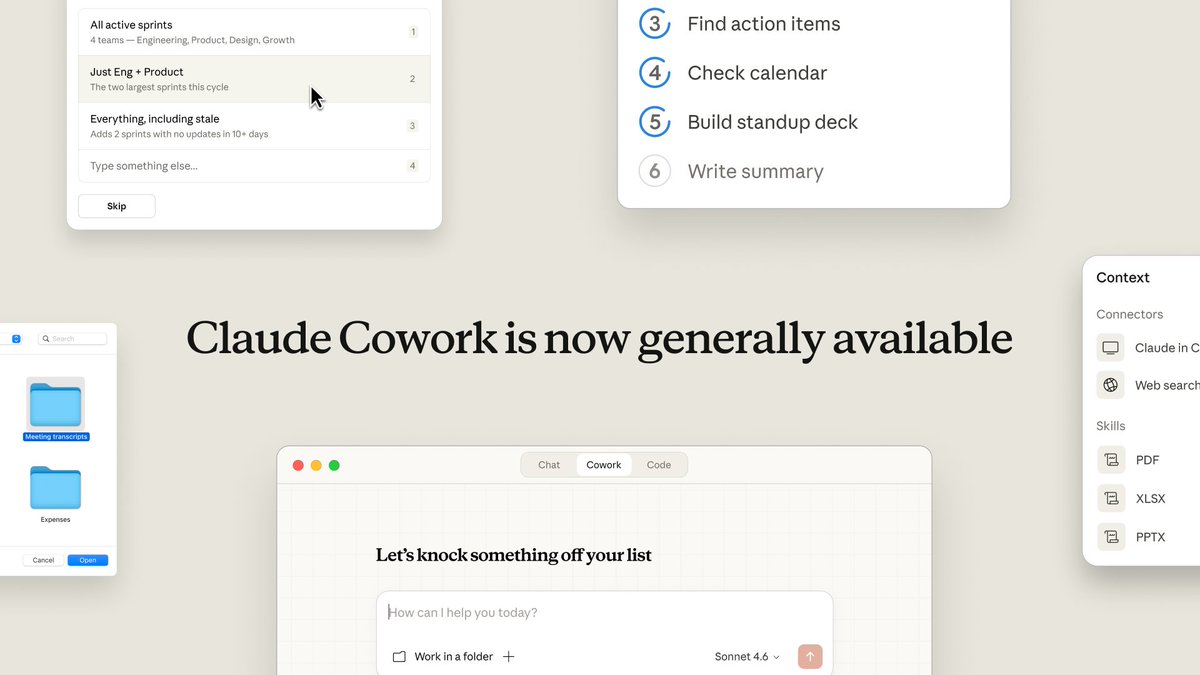
Claude Cowork is now generally available to all paid plans. For Enterprise, we are adding role-based access controls, group spend limits, usage analytics, and expanded OpenTelemetry to give admins what they need to deploy it across the org.
We're bringing the advisor strategy to the Claude Platform. Pair Opus as an advisor with Sonnet or Haiku as an executor, and get near Opus-level intelligence in your agents at a fraction of the cost.
New on the Engineering Blog: Building Managed Agents—our hosted service for long-running agents—meant solving an old problem in computing: how to design a system for “programs as yet unthought of.”
Shipping a production agent meant months of infrastructure work first. Managed Agents handles that for you. Define your agent's tasks, tools, and guardrails, and we run it on our infrastructure. Here's what early customers have built:
Introducing Project Glasswing: an urgent initiative to help secure the world’s most critical software. It’s powered by our newest frontier model, Claude Mythos Preview, which can find software vulnerabilities better than all but the most skilled humans.
We've signed an agreement with Google and Broadcom for multiple gigawatts of next-generation TPU capacity, coming online starting in 2027, to train and serve frontier Claude models.
New Anthropic Fellows Research: a new method for surfacing behavioral differences between AI models. We apply the “diff” principle from software development to compare open-weight AI models and identify features unique to each.
These vectors shape Claude’s behavior. When we present the model with pairs of activities, emotion vector activations shape its preferences. If an activity lights up the “joy” vector, the model prefers it; if it lights up “offended” or “hostile,” the model rejects it.